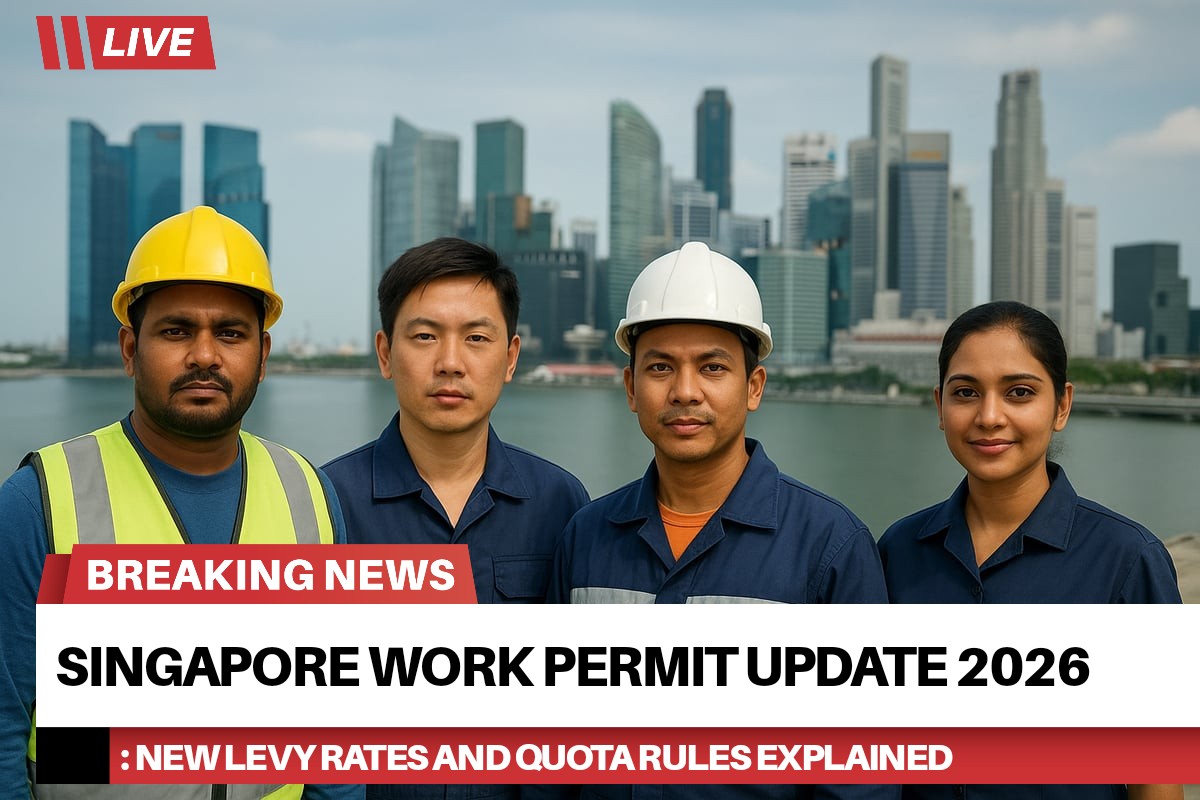
The Singapore government regularly updates its foreign workforce policies to balance business needs and employment opportunities for local workers. In 2026, several important updates have been introduced to the Work Permit system, including changes to levy rates, quota rules, and employment policies.
These updates affect employers who hire foreign workers as well as migrant workers seeking employment opportunities in Singapore. The new rules aim to simplify the levy framework, manage the number of foreign workers in different sectors, and encourage businesses to hire higher-skilled employees. 0
Also read
अब बुजुर्गों के लिए और आसान होगी जिंदगी, सरकार ने बढ़ाईं कई सुविधाएं – Senior Citizen Scheme
Student Free Laptop Yojana: सरकार दे रही फ्री लैपटॉप, 10वीं–12वीं छात्रों के लिए आवेदन शुरू
This guide explains the Singapore Work Permit Update 2026, including the latest levy rates, quota limits, and what these changes mean for employers and workers.
What Is a Singapore Work Permit?
A Work Permit is a type of employment pass issued by Singapore’s Ministry of Manpower (MOM) that allows foreign workers to work in specific sectors such as construction, manufacturing, marine shipyard, process, and services.
Also read
अब महिलाओं के खाते में आएंगे ₹1500, बस करना होगा ये छोटा सा काम – Ladki Bahin Yojana eKYC Update
These permits are typically issued to semi-skilled or basic-skilled workers and are sponsored by employers. The government controls the number of foreign workers through two main mechanisms:
- Foreign Worker Levy – A monthly fee employers must pay for each foreign worker.
- Quota (Dependency Ratio Ceiling) – The maximum percentage of foreign workers a company can hire.
These policies help maintain a balanced workforce while ensuring companies still have access to global talent.
Key Singapore Work Permit Changes in 2026
Several policy adjustments have been introduced to modernize the work permit system and improve workforce planning for businesses.
Main Highlights
- Simplified levy structure for some sectors
- Adjustments to foreign worker quotas
- Changes to levy rates for certain industries
- Policies encouraging employers to hire higher-skilled workers
The Ministry of Manpower aims to make the levy framework easier to understand while ensuring firms relying heavily on foreign workers contribute higher levies. 1
New Levy Rates for Work Permit Holders
The foreign worker levy varies depending on the sector, skill level, and dependency ratio used by the employer. Basic-skilled workers generally attract higher levy rates compared to higher-skilled workers.
Below is an overview of typical levy ranges across different sectors.
| Worker Category | Monthly Levy (Approx.) | Description |
|---|---|---|
| Higher-Skilled Workers (R1) | S$200 – S$350 | Lower levy for workers with higher skills |
| Basic-Skilled Workers (R2) | S$470 – S$800 | Higher levy for entry-level foreign workers |
| S Pass Holders | S$650 | Standardized levy rate from September 2025 |
For example, the S Pass levy rate has been standardized to S$650 per month across all sectors starting from September 2025. 2
Levy Changes Announced in Budget 2026
The Singapore Budget 2026 also introduced specific levy adjustments for certain industries.
According to the announcement:
- Levy for basic-skilled workers in the marine shipyard sector will increase by S$100.
- Levy for basic-skilled workers in the process sector will increase by S$150.
- Higher-skilled worker levies will remain unchanged.
These changes will gradually take effect and are designed to align levy structures across sectors while encouraging productivity improvements. 3
Understanding the Foreign Worker Quota System
Singapore uses a quota system known as the Dependency Ratio Ceiling (DRC). This rule limits how many foreign workers a company can employ compared to its number of local employees.
For example:
- In the services sector, foreign workers can make up to 35% of the workforce.
- Companies must hire local employees in order to qualify for more foreign worker permits.
If a company exceeds its quota, it may not be able to apply for new work permits until the workforce ratio returns to the allowed level. 4
New Quota Adjustments for Employers
The government has also introduced changes to simplify quota tiers and improve workforce planning.
Important updates include:
- Merging some levy tiers for the manufacturing and services sectors
- Higher levy rates for companies heavily dependent on foreign workers
- Encouraging companies to hire and train local employees
These adjustments aim to ensure foreign workers complement the local workforce rather than replace it.
Other Important Work Permit Policy Changes
Besides levy and quota updates, Singapore has also introduced broader policy changes affecting work permit holders.
1. Removal of Employment Time Limit
Previously, migrant workers were allowed to work in Singapore for a maximum period of 14 to 26 years depending on their sector and nationality. This limit has now been removed, allowing companies to retain experienced workers longer. 5
2. Higher Maximum Working Age
Work Permit holders can now continue working until 63 years old if they meet health and employment requirements.
3. Expanded Job Roles
More occupations are gradually being opened to foreign workers, particularly in sectors facing labour shortages.
What These Changes Mean for Employers
For businesses in Singapore, the updated rules require better workforce planning and compliance with government regulations.
Employers should focus on:
- Maintaining the correct foreign worker quota
- Paying levy fees on time
- Training higher-skilled workers
- Hiring local workers to balance workforce ratios
Companies that fail to follow these rules may face fines, restrictions on hiring foreign workers, or other enforcement actions.
What Foreign Workers Should Know
Foreign workers planning to work in Singapore should also stay informed about these changes.
- Work permits must be sponsored by an employer
- Levy fees are paid by employers, not workers
- Workers must follow employment and immigration regulations
- Valid medical insurance and employment contracts are required
Understanding the rules can help workers avoid problems with immigration or employment compliance.
Conclusion
The Singapore Work Permit Update 2026 introduces several important changes, including updated levy rates, simplified quota rules, and improvements to the foreign workforce framework. These reforms aim to create a more balanced labour market while ensuring businesses can still hire skilled workers from abroad.
For employers, the key focus will be on workforce planning and compliance with levy payments and quota rules. For foreign workers, understanding the new regulations is essential for maintaining legal employment in Singapore.
As Singapore continues to refine its workforce policies, both companies and workers should stay updated with the latest announcements from the Ministry of Manpower.
Frequently Asked Questions (FAQs)
1. What is the Singapore foreign worker levy?
The foreign worker levy is a monthly fee paid by employers for each foreign worker they hire under a Work Permit or S Pass.
2. What is the S Pass levy rate in Singapore?
The S Pass levy rate has been standardized at S$650 per month across all sectors. 6
3. What is the foreign worker quota in Singapore?
The quota, also known as the Dependency Ratio Ceiling (DRC), limits how many foreign workers a company can employ relative to its local workforce.
4. Has the employment time limit for work permit holders been removed?
Yes, the previous maximum employment period has been removed, allowing experienced workers to stay longer if they meet eligibility rules. 7
5. Do workers pay the foreign worker levy?
No. The foreign worker levy must be paid by the employer, not the employee.
“`8